Monday, February 1, 2010
Rotorua, New Zealand
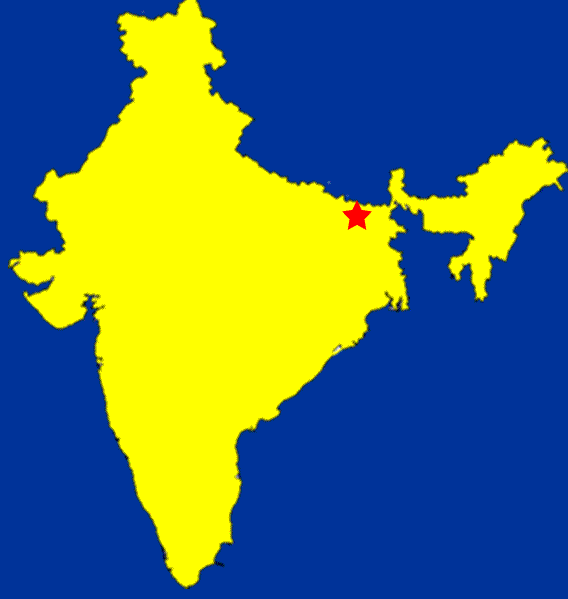
After 4 days of travel (Puri>Kolcata>Singapore>New Zealand) I arrived in Auckland and was joined by my parents and my sister 5 hours later. We rented a car and drove to a beautiful lake surrounded by geyers and mountain biking trails. Here I plan to do some fishing and go to the hot springs. Love to everyone.

Saturday, January 16, 2010
Final days in Bodh Gaya
Late last night I arrived in Puri after a long train that didn't leave Gaya till 4am it was 4hrs late. But now I'm rested and relaxed. Puri is fit to burst right now because of the upcoming Hindu festival at the Jangannath Temple built in the 12th century I haven't been yet, but I plan to have a look. Non-Hindus cannot enter the temple but the view from across the street is supposed to be not bad. I found a nice, cheap room this morning at the Derby hotel. It is a small guest house close enough to the ocean you can hear it and it has a nice little garden restaurant to read in. My luggage has doubled since arriving in India because of how cheap the books were in Bodh Gaya. I had my tailor make me a bag (which just fits the maximum carry on) and filled it to the brim with books, so I have plenty to read.
Bodh Gaya was incredible in the month of January. Busy with westerners and monks from all over the Indian sub-continent and the Himalayan region. The tent set up for the Dalai Lama's teachings could have probably covered a football field and every day people were forced to sit in the neighboring fields after it filled completely. He spoke on issues concerning the adaptation of Tibetan Buddhism (and Buddhists) to the modern and he taught from 'lam rim' (stages of the path) texts. He emphasized the unification of the Tibetan schools by picking texts from Nyingma and Kagyupa traditions as well as his, Gelukpa tradition. On the last day he spoke directly to the foreigners, some 50 countries were represented, America, Russia and France had the largest turnout. He told us to genuinely study the dharma and then to apply it to our lives. He also urged us to visit Tibet, as the situation there is distorted by the Chinese authorities. During these teachings and after Jon and I attended Phowa teaching taught by Ayang Rinpoche. For about ten days 10-12 hours of dharma teachings was the norm. These teachings were every bit worth it (that is why I extended my train ticket). I met practicing Buddhists from all over the world and I hope made some lasting connections.
Saying good-bye to Bodh Gaya was easy. That last night I ate a great home-cooked meal a friend's house. Suneil's mother was kind enough to cook for 4 others and I as a good-bye gift, it was delicious Khichadi. The stupa was beautiful, lit up for the Nyingma monlam and the Bodhi tree was truly magnificent. Under the tree was a large group of people meditating, I knew many faces. Some I had met in the Burmese Vihar, some I had received teachings with, some were ex-Antioch students. It was a great community and I will not soon forget it. Jon and I gave the Abbot of the Burmese Vihar a vase and a flower to show our appreciation for his kindness. After 5 months I had grown to love Bodh Gaya for its trash heaps and its history and its people. It is an extremely unique place because of the seeming similarity and underlying diversity the people who visit.
Bodh Gaya was incredible in the month of January. Busy with westerners and monks from all over the Indian sub-continent and the Himalayan region. The tent set up for the Dalai Lama's teachings could have probably covered a football field and every day people were forced to sit in the neighboring fields after it filled completely. He spoke on issues concerning the adaptation of Tibetan Buddhism (and Buddhists) to the modern and he taught from 'lam rim' (stages of the path) texts. He emphasized the unification of the Tibetan schools by picking texts from Nyingma and Kagyupa traditions as well as his, Gelukpa tradition. On the last day he spoke directly to the foreigners, some 50 countries were represented, America, Russia and France had the largest turnout. He told us to genuinely study the dharma and then to apply it to our lives. He also urged us to visit Tibet, as the situation there is distorted by the Chinese authorities. During these teachings and after Jon and I attended Phowa teaching taught by Ayang Rinpoche. For about ten days 10-12 hours of dharma teachings was the norm. These teachings were every bit worth it (that is why I extended my train ticket). I met practicing Buddhists from all over the world and I hope made some lasting connections.
Saying good-bye to Bodh Gaya was easy. That last night I ate a great home-cooked meal a friend's house. Suneil's mother was kind enough to cook for 4 others and I as a good-bye gift, it was delicious Khichadi. The stupa was beautiful, lit up for the Nyingma monlam and the Bodhi tree was truly magnificent. Under the tree was a large group of people meditating, I knew many faces. Some I had met in the Burmese Vihar, some I had received teachings with, some were ex-Antioch students. It was a great community and I will not soon forget it. Jon and I gave the Abbot of the Burmese Vihar a vase and a flower to show our appreciation for his kindness. After 5 months I had grown to love Bodh Gaya for its trash heaps and its history and its people. It is an extremely unique place because of the seeming similarity and underlying diversity the people who visit.
Thursday, December 17, 2009
Sittings-Teachings-Reading
Being back in Bodh Gaya is great! The last week with the rest of the students flew by and I finally said goodbye to them on Wednesday. The last meditation session at the Mahabodhi followed by a butter lamp offering concluded the program. They have safely arrived in Delhi and fly London today at one. The Vihar is extremely quiet now, only the faculty, four students, Yogi Mike, the Burmese and two newcomers are currently here.
The city itself is the opposite. The Hindustan Times believes that the quantity of tourists this year is double that of last year. The restaurants are full of westerns and the temple is very congested. Currently: there is a small monlam going on at the temple, the city is building a massive structure to house the 50,000 people arriving for the Dalai Lama's teachings, and Tergar Monastery (the Karmapa's seat in Bodh Gaya) is preparing for teachings on Nagarjuna's "Letter to a Friend," which start on Sunday. As the title implies I have been taking it very easy although last night a few friends and I met with a woman who needs volunteers for her campaign to clean up Bodh Gaya. I'm not sure how involved I will be, but it sounds exciting.
The schedule for the next few weeks is going to be something like this:
Dec. 20-22 Karmapa's teachings at Tergar
Dec. 24-30 Kaygu Monlam (hopefully we will get permission to camp at the Temple for some of these days)
Jan 1st (tentatively) The Karmapa's opera on the life of Milarepa will debut.
Jan 5-10 Dalai Lama's teachings at Kalachakra field
Also, the remaining falculty and students have a Christmas breakfast and gift exchange so I wont be missing the festivities entirely.
The city itself is the opposite. The Hindustan Times believes that the quantity of tourists this year is double that of last year. The restaurants are full of westerns and the temple is very congested. Currently: there is a small monlam going on at the temple, the city is building a massive structure to house the 50,000 people arriving for the Dalai Lama's teachings, and Tergar Monastery (the Karmapa's seat in Bodh Gaya) is preparing for teachings on Nagarjuna's "Letter to a Friend," which start on Sunday. As the title implies I have been taking it very easy although last night a few friends and I met with a woman who needs volunteers for her campaign to clean up Bodh Gaya. I'm not sure how involved I will be, but it sounds exciting.
The schedule for the next few weeks is going to be something like this:
Dec. 20-22 Karmapa's teachings at Tergar
Dec. 24-30 Kaygu Monlam (hopefully we will get permission to camp at the Temple for some of these days)
Jan 1st (tentatively) The Karmapa's opera on the life of Milarepa will debut.
Jan 5-10 Dalai Lama's teachings at Kalachakra field
Also, the remaining falculty and students have a Christmas breakfast and gift exchange so I wont be missing the festivities entirely.
Saturday, December 5, 2009
Heading home to the Vihar
So, the traveling as been smooth the paper is printed (I can email a copy to anyone interested) and tomorrow we begin to go back to Bodh Gaya, via Kolcata which is extremely out of the way. Since I lasted posted Alex, Chimi and I have stayed four days in Ralang Sikkim, one day in Tashiding Sikkim, six nights in Gangtok (the capital of Sikkim), and one night in Darjeeling (in the West Bengal hills).
Ralang is extremely remote and absolutely gorgeous. On a clear day we could see the entire eastern range of the Himalayas centered by Kanchenjunga. Palchen Choeling is the resident monastery of Gyaltsap Rinpoche, one of the four regents(teachers, kinda) of the 17th Karmapa. The interview with him was pretty powerful. No one spoke English except a monk that traveled with us from Rumtek named Lekthong. We are very fortunate to become friends with him for many reasons. For instance, he broke down my ideolized stereotypes of the buddhist monk with his macbook pro, his knowledge of American pop culture (from which he taught himself english), and his attitude towards buddhist philosophy and retreat. Other then a few interviews we hacky sached with the young monks, enjoyed the views, took a day trip to Tashiding (perhaps the most sacred place in Sikkim as it was blessed by Padmasambhava in the 7th or 8th century), and worked. We had all meals in the monastic dining hall, which provided us with a lot to look at. After cabin fever became intolerable we traveled back to the capital to finalize our papers.
Gangtok is, from what I have seen, the nicest city in India. It is very clean and has, by far, the largest police force. Money is poured into Sikkim by the Indian government to keep its residents happy and keep the security high because it borders China. The outfits of the officers are quite funny: french berets, thick white belts, high boots, and green woolen sweaters. There is a nice wide walking mall called MG Marg where you could get into a lot of trouble for spitting or smoking. During the day I wrote, either in a cyber cafe or on the top floor of Yeshe Dorje's house, where we stayed. The Dorje's have the most beautiful shine room for meditation. If anyone is interested in traveling to Sikkim or Bhutan tell me so you can join a travel group led by his son Pema. The family is extremely kind and extremely influential in the Tibetan Buddhist community. They technically hold the lineage to the teachings of an esoteric form of yoga and are considered royality amongst Tibetans. We were extermely fortunate to stay with them. Also staying at the Dorjes' was a student pursuing a doctorate degree in Indo-Tibetan 'treasure texts' who graduated from Naropa and got married at the Shamabala center in Boulder, small world. While I wasn't writing we went to many bars throughout Gangtok, the funniest was a karioke bar. Five days later we were off to Darjeeling.
Darjeeling is totally anticlimatic. Both yesterday and today have been extremely gloomy and overcast. The remains of the once luxerious colonial summer retreat have not been upkept. There are many Tibetan curio shops, which are fun to look through, I finally bought a singing bowl. The forest surrounding these hills is dense and the only crops cultivated in this part of the world are some of the finest teas in the world. I'm looking forward to getting back to the Vihar. Robert, hopefully, has set up a private audience with the HH the 17th Karmapa.
Ralang is extremely remote and absolutely gorgeous. On a clear day we could see the entire eastern range of the Himalayas centered by Kanchenjunga. Palchen Choeling is the resident monastery of Gyaltsap Rinpoche, one of the four regents(teachers, kinda) of the 17th Karmapa. The interview with him was pretty powerful. No one spoke English except a monk that traveled with us from Rumtek named Lekthong. We are very fortunate to become friends with him for many reasons. For instance, he broke down my ideolized stereotypes of the buddhist monk with his macbook pro, his knowledge of American pop culture (from which he taught himself english), and his attitude towards buddhist philosophy and retreat. Other then a few interviews we hacky sached with the young monks, enjoyed the views, took a day trip to Tashiding (perhaps the most sacred place in Sikkim as it was blessed by Padmasambhava in the 7th or 8th century), and worked. We had all meals in the monastic dining hall, which provided us with a lot to look at. After cabin fever became intolerable we traveled back to the capital to finalize our papers.
Gangtok is, from what I have seen, the nicest city in India. It is very clean and has, by far, the largest police force. Money is poured into Sikkim by the Indian government to keep its residents happy and keep the security high because it borders China. The outfits of the officers are quite funny: french berets, thick white belts, high boots, and green woolen sweaters. There is a nice wide walking mall called MG Marg where you could get into a lot of trouble for spitting or smoking. During the day I wrote, either in a cyber cafe or on the top floor of Yeshe Dorje's house, where we stayed. The Dorje's have the most beautiful shine room for meditation. If anyone is interested in traveling to Sikkim or Bhutan tell me so you can join a travel group led by his son Pema. The family is extremely kind and extremely influential in the Tibetan Buddhist community. They technically hold the lineage to the teachings of an esoteric form of yoga and are considered royality amongst Tibetans. We were extermely fortunate to stay with them. Also staying at the Dorjes' was a student pursuing a doctorate degree in Indo-Tibetan 'treasure texts' who graduated from Naropa and got married at the Shamabala center in Boulder, small world. While I wasn't writing we went to many bars throughout Gangtok, the funniest was a karioke bar. Five days later we were off to Darjeeling.
Darjeeling is totally anticlimatic. Both yesterday and today have been extremely gloomy and overcast. The remains of the once luxerious colonial summer retreat have not been upkept. There are many Tibetan curio shops, which are fun to look through, I finally bought a singing bowl. The forest surrounding these hills is dense and the only crops cultivated in this part of the world are some of the finest teas in the world. I'm looking forward to getting back to the Vihar. Robert, hopefully, has set up a private audience with the HH the 17th Karmapa.
Monday, November 23, 2009
The Darjeeling Hills and Sikkim
Right now I feel that finals week was more than just 10 days ago, but classes and tests ended very well and Chimi, Alex and I departed for Calcutta that friday evening. We arrived early and took a cap to the other train station, Sealdah, where we were going to be departing that night. We rented a lodge near the station to make the departure convenient but ran into the issue of many hotels not allowing foreigners to stay, kinda strange. The area of Kolcata was extremely dirty but we enjoyed walking through the markets and reading on the roof of our hotel. We left for NJP station in the most northern part of West Bengal at 10pm and arrived at 8 the next morning. I was surprised by how little the land had changed; flooded rice fields dotted with small villages and cattle roaming freely was still the norm.
The three of us arranged a car to take us about 2 and a half hours into the Darjeeling hills. Now we started to see some geographical changes, climate changes as well. The vegetation is lush, like a temperate rain forest and the only humans in sight are the ethically Nepali leaf pickers in the expansive tea field covering the steep hills. They wear thatched baskets on their by strapping the weight of the baskets on their foreheads, looks a little rough on the neck. Our destination is Mirik, founded as a hill station by the British. It is beautiful. Surrounded by forested hills it is the home to about 10 thousand (mostly 2nd generation immigrants from Nepal and Bhutia peoples). The Bhutia immigrated to the Sikkim region in the 13th (more or less) from Tibet. They are considered to be the 'Buddhists' of the region. At the base of the hill is an artificial lake, which one day we took a paddle boat ride in. From the lake the most stunning building is the massive monastery about half way up the hill. We stayed in its guest house for 5days. It is a Tibetan monastery of the Kagyu lineage and was built in the eighties to house Bokar Rinpoche as he fled Tibet. Two retreat centers a part of the monastery complex and I had lots of chances to interview the Rinpoche, the retreat manager, and many lamas. It was very productive. The office receptionist was named Karma Thupten, he is a very kind man, and we became good friends. He took us all over Mirik. The weather was a little cold, the fog would roll in thicker than I had ever seen every afternoon, which made doing laundry impossible but was a cool effect. Sometimes the visibility would be 25-50 ft. The mornings for the most part were clear though; one morning we were given an unbelievable view of Kanchenjunga, the world's third highest mountain, to the north. Our room was great, there was a community kitchen in the guest house which allowed us to meet the other guests. One night we cooked pasta alfredo with garlic bread for Karma which turned out really mushy. There was no internet cafe in town which is why I wasn't able to post earlier. Mirik was unbelievable, so far from Bihar, I cannot believe it is the same country. All the houses were surrounded by potted orchids and had little gardens out front. They were all painted vibrant colors like lime green and light blue. Anyways, it was beautiful, I found it hard to do the prescribed 6-8 hr/day on my project. But its coming along.
It was the 20th of November, I think, that we continued along to Sikkim. We were originally planing to go to Darjeeling but there was a strike and the roads were shut down. The Darjeeling hills are trying to form their own state, Gorkhaland, and they try to get the attention of the central government to notice by closing down the economy entirely for days at a time hoping that someone with power will complain. It is not dangerous but it is an inconvenience. So instead we went to Rumtek monastery near Gantok in Sikkim, it is the headquarters of the Kagyu lineage and the HH the 17th Karmapa's monastery but he is not allowed to Sikkim for some reason or another. Ask the Indian government. Rumtek is beautiful as well: massive rivers, dense forests and steep hills terraced with rice fields comprise most of the land. The himalayas make up the backdrop. The monastery guest house provides us with meals when we like, as did Mirik Monastery, and we also walk down the hill to eat at the local restaurants. The monasteries welcome us and are very hospitable, the high lama, Khenpos and Rinpoches are always very generous with their time and maybe even interested to meet us. The shrine rooms are stunning and the monastics are great to speak to, I was not expecting this level of hospitality.
Next stop is Ralong, another Kagyu monastery, to the west. I highly doubt that it will have an internet cafe it is suppose to be extremely remote. After we will briefly visit Tashiding and then come back to Gantok to write the papers. Hope everyone is well.
The three of us arranged a car to take us about 2 and a half hours into the Darjeeling hills. Now we started to see some geographical changes, climate changes as well. The vegetation is lush, like a temperate rain forest and the only humans in sight are the ethically Nepali leaf pickers in the expansive tea field covering the steep hills. They wear thatched baskets on their by strapping the weight of the baskets on their foreheads, looks a little rough on the neck. Our destination is Mirik, founded as a hill station by the British. It is beautiful. Surrounded by forested hills it is the home to about 10 thousand (mostly 2nd generation immigrants from Nepal and Bhutia peoples). The Bhutia immigrated to the Sikkim region in the 13th (more or less) from Tibet. They are considered to be the 'Buddhists' of the region. At the base of the hill is an artificial lake, which one day we took a paddle boat ride in. From the lake the most stunning building is the massive monastery about half way up the hill. We stayed in its guest house for 5days. It is a Tibetan monastery of the Kagyu lineage and was built in the eighties to house Bokar Rinpoche as he fled Tibet. Two retreat centers a part of the monastery complex and I had lots of chances to interview the Rinpoche, the retreat manager, and many lamas. It was very productive. The office receptionist was named Karma Thupten, he is a very kind man, and we became good friends. He took us all over Mirik. The weather was a little cold, the fog would roll in thicker than I had ever seen every afternoon, which made doing laundry impossible but was a cool effect. Sometimes the visibility would be 25-50 ft. The mornings for the most part were clear though; one morning we were given an unbelievable view of Kanchenjunga, the world's third highest mountain, to the north. Our room was great, there was a community kitchen in the guest house which allowed us to meet the other guests. One night we cooked pasta alfredo with garlic bread for Karma which turned out really mushy. There was no internet cafe in town which is why I wasn't able to post earlier. Mirik was unbelievable, so far from Bihar, I cannot believe it is the same country. All the houses were surrounded by potted orchids and had little gardens out front. They were all painted vibrant colors like lime green and light blue. Anyways, it was beautiful, I found it hard to do the prescribed 6-8 hr/day on my project. But its coming along.
It was the 20th of November, I think, that we continued along to Sikkim. We were originally planing to go to Darjeeling but there was a strike and the roads were shut down. The Darjeeling hills are trying to form their own state, Gorkhaland, and they try to get the attention of the central government to notice by closing down the economy entirely for days at a time hoping that someone with power will complain. It is not dangerous but it is an inconvenience. So instead we went to Rumtek monastery near Gantok in Sikkim, it is the headquarters of the Kagyu lineage and the HH the 17th Karmapa's monastery but he is not allowed to Sikkim for some reason or another. Ask the Indian government. Rumtek is beautiful as well: massive rivers, dense forests and steep hills terraced with rice fields comprise most of the land. The himalayas make up the backdrop. The monastery guest house provides us with meals when we like, as did Mirik Monastery, and we also walk down the hill to eat at the local restaurants. The monasteries welcome us and are very hospitable, the high lama, Khenpos and Rinpoches are always very generous with their time and maybe even interested to meet us. The shrine rooms are stunning and the monastics are great to speak to, I was not expecting this level of hospitality.
Next stop is Ralong, another Kagyu monastery, to the west. I highly doubt that it will have an internet cafe it is suppose to be extremely remote. After we will briefly visit Tashiding and then come back to Gantok to write the papers. Hope everyone is well.
Saturday, November 7, 2009
Final's Week
On Saturday the group traveled 2 hrs north to Rajgir (the capital and largest city of the Buddha's world). It's incredible because Old Rajgir has not been a city of prominence and wealth for 2500 years, so it has not been built over. The Ruins were magnificent. Vulture's peak is the location that the Buddha delivered many of his most important early teachings and gained legitimacy among ascetics. We also visited the locations of the first Buddhist monastery (a mango grove) and a few retreat caves in the hills. Afterwards we went to the ruins of Nalanda which were truly impressive. It was first constructed in fifth century and grew until its destruction in 1193 by Muslim invaders who miss took it for a fortress. At its peak, this university housed 8500 students from all over Asia, and 1500 teachers. Many famous scholars went to this university. It is 7km by 3km in size and contains 11 7 story monasteries for lectures and residencies and an 11 story library. Today these massive brick buildings are reduced to 3 stories. Apart from the impression the structures left on me, it is remarkable to reflect on what the place was like as Shantideva gave his Bodhicaryavatara. Again if interested in the details refer the Claire's blog.
Anyways, got finals this week and then off to Sikkim and my project. I feel as if I arrived in India a year ago and at the same time that time has flown by.
Anyways, got finals this week and then off to Sikkim and my project. I feel as if I arrived in India a year ago and at the same time that time has flown by.
Tuesday, November 3, 2009
The Rinpoche's visit and plans for the Independent Study
Last week we were taught by the highly respected Kaygu Lama and inspiration for Yoda, Chokyi Nyima Rinpoche. The resemblance to Yoda is visible in the way he sat, the way he laughed, and the wisdom he spoke. Also he could not have been taller than 5'4". More importantly he is a very inspiring figure personifying both wisdom and compassion. We gathered in both morning and evening for Dharma talks and meditation. For a complete break down of our week with Rinpoche please follow the link to my friend Claire's blog (bottom right of screen under resources). Her blog is significantly more thorough, it contains pictures and in all manners is more satisfactory. I will not compete with it because I will inevitably lose. Anyways, I am doing well. Staying extremely busy and having fun. There are 10 more days of class, so finals are approaching. We had a Halloween party at a nice hotel and I dressed up like a genie (I'll look around for pictures). And this weekend we are going to Nalanda which was the largest Buddhist University in Asia from about 200 CE to 1300 CE until invading Mughals (I think) tore it down. This archeological ruins are supposed to be spectacular.
Much of what I am currently busying myself with now is my plans for next month. I will be doing anthropological fieldwork in Sikkim India. Sikkim is between Nepal and Bhutan, and it is north of Bangladesh. It was a Buddhist kingdom until it was annexed by India in 1974. It is difficult to know what the situation was because all the Indian literature say it was peacful and for the benefit of the different ethic groups inhabiting the area. Sikkimese literature doesn't agree but doesn't offer a separate and concrete account of the events. What is known for sure is that the location is extremely strategic as it creates a border between India and China. Anyways, the King stepped down and now it is known for its eco-friendly tourism and its rice (Sikkim = De-zong in Tibetan = Land of rice). I plan to travel with two friends Chimi Lama and Alex Rayburn, between four Monasteries (Tibetan tradition, Nyingma school) in southern Sikkim (now the name of the province) to study the structure of retreat. Retreat centers are part of the greater monastic institution and provide a place for monks to live in solitude for a period of time to meditiate. They usually are within a days walk to the monastery so that food and other supplies may be brought up to them. I am going to look at this relationship between the monastery and the retreat center asking questions like: What is the role of solitude in Buddhism, why and how does this ideal exist? Further, how do the retreat centers work and what is to be gained from them? It should be interesting and I think I wont have too big of an issue finding monks, Rinpoches, and retreat managers to interview. I am particularly happy with this topic because it allows me to interact with all sorts of people and travel. So, I leave in 12 days. Until then I'll be busily studying>
Also, as of now I'm planning to go south to the state of Orissa and go to the beach for the month of January. Anyone who wants to join me is welcome.
Much of what I am currently busying myself with now is my plans for next month. I will be doing anthropological fieldwork in Sikkim India. Sikkim is between Nepal and Bhutan, and it is north of Bangladesh. It was a Buddhist kingdom until it was annexed by India in 1974. It is difficult to know what the situation was because all the Indian literature say it was peacful and for the benefit of the different ethic groups inhabiting the area. Sikkimese literature doesn't agree but doesn't offer a separate and concrete account of the events. What is known for sure is that the location is extremely strategic as it creates a border between India and China. Anyways, the King stepped down and now it is known for its eco-friendly tourism and its rice (Sikkim = De-zong in Tibetan = Land of rice). I plan to travel with two friends Chimi Lama and Alex Rayburn, between four Monasteries (Tibetan tradition, Nyingma school) in southern Sikkim (now the name of the province) to study the structure of retreat. Retreat centers are part of the greater monastic institution and provide a place for monks to live in solitude for a period of time to meditiate. They usually are within a days walk to the monastery so that food and other supplies may be brought up to them. I am going to look at this relationship between the monastery and the retreat center asking questions like: What is the role of solitude in Buddhism, why and how does this ideal exist? Further, how do the retreat centers work and what is to be gained from them? It should be interesting and I think I wont have too big of an issue finding monks, Rinpoches, and retreat managers to interview. I am particularly happy with this topic because it allows me to interact with all sorts of people and travel. So, I leave in 12 days. Until then I'll be busily studying>
Also, as of now I'm planning to go south to the state of Orissa and go to the beach for the month of January. Anyone who wants to join me is welcome.
Subscribe to:
Posts (Atom)