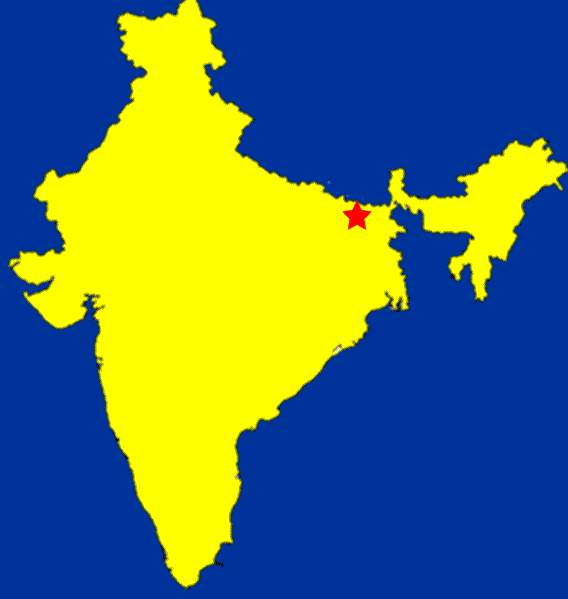
Being back in Bodh Gaya is great! The last week with the rest of the students flew by and I finally said goodbye to them on Wednesday. The last meditation session at the Mahabodhi followed by a butter lamp offering concluded the program. They have safely arrived in Delhi and fly London today at one. The Vihar is extremely quiet now, only the faculty, four students, Yogi Mike, the Burmese and two newcomers are currently here.
The city itself is the opposite. The Hindustan Times believes that the quantity of tourists this year is double that of last year. The restaurants are full of westerns and the temple is very congested. Currently: there is a small monlam going on at the temple, the city is building a massive structure to house the 50,000 people arriving for the Dalai Lama's teachings, and Tergar Monastery (the Karmapa's seat in Bodh Gaya) is preparing for teachings on Nagarjuna's "Letter to a Friend," which start on Sunday. As the title implies I have been taking it very easy although last night a few friends and I met with a woman who needs volunteers for her campaign to clean up Bodh Gaya. I'm not sure how involved I will be, but it sounds exciting.
The schedule for the next few weeks is going to be something like this:
Dec. 20-22 Karmapa's teachings at Tergar
Dec. 24-30 Kaygu Monlam (hopefully we will get permission to camp at the Temple for some of these days)
Jan 1st (tentatively) The Karmapa's opera on the life of Milarepa will debut.
Jan 5-10 Dalai Lama's teachings at Kalachakra field
Also, the remaining falculty and students have a Christmas breakfast and gift exchange so I wont be missing the festivities entirely.
Thursday, December 17, 2009

Saturday, December 5, 2009
Heading home to the Vihar
So, the traveling as been smooth the paper is printed (I can email a copy to anyone interested) and tomorrow we begin to go back to Bodh Gaya, via Kolcata which is extremely out of the way. Since I lasted posted Alex, Chimi and I have stayed four days in Ralang Sikkim, one day in Tashiding Sikkim, six nights in Gangtok (the capital of Sikkim), and one night in Darjeeling (in the West Bengal hills).
Ralang is extremely remote and absolutely gorgeous. On a clear day we could see the entire eastern range of the Himalayas centered by Kanchenjunga. Palchen Choeling is the resident monastery of Gyaltsap Rinpoche, one of the four regents(teachers, kinda) of the 17th Karmapa. The interview with him was pretty powerful. No one spoke English except a monk that traveled with us from Rumtek named Lekthong. We are very fortunate to become friends with him for many reasons. For instance, he broke down my ideolized stereotypes of the buddhist monk with his macbook pro, his knowledge of American pop culture (from which he taught himself english), and his attitude towards buddhist philosophy and retreat. Other then a few interviews we hacky sached with the young monks, enjoyed the views, took a day trip to Tashiding (perhaps the most sacred place in Sikkim as it was blessed by Padmasambhava in the 7th or 8th century), and worked. We had all meals in the monastic dining hall, which provided us with a lot to look at. After cabin fever became intolerable we traveled back to the capital to finalize our papers.
Gangtok is, from what I have seen, the nicest city in India. It is very clean and has, by far, the largest police force. Money is poured into Sikkim by the Indian government to keep its residents happy and keep the security high because it borders China. The outfits of the officers are quite funny: french berets, thick white belts, high boots, and green woolen sweaters. There is a nice wide walking mall called MG Marg where you could get into a lot of trouble for spitting or smoking. During the day I wrote, either in a cyber cafe or on the top floor of Yeshe Dorje's house, where we stayed. The Dorje's have the most beautiful shine room for meditation. If anyone is interested in traveling to Sikkim or Bhutan tell me so you can join a travel group led by his son Pema. The family is extremely kind and extremely influential in the Tibetan Buddhist community. They technically hold the lineage to the teachings of an esoteric form of yoga and are considered royality amongst Tibetans. We were extermely fortunate to stay with them. Also staying at the Dorjes' was a student pursuing a doctorate degree in Indo-Tibetan 'treasure texts' who graduated from Naropa and got married at the Shamabala center in Boulder, small world. While I wasn't writing we went to many bars throughout Gangtok, the funniest was a karioke bar. Five days later we were off to Darjeeling.
Darjeeling is totally anticlimatic. Both yesterday and today have been extremely gloomy and overcast. The remains of the once luxerious colonial summer retreat have not been upkept. There are many Tibetan curio shops, which are fun to look through, I finally bought a singing bowl. The forest surrounding these hills is dense and the only crops cultivated in this part of the world are some of the finest teas in the world. I'm looking forward to getting back to the Vihar. Robert, hopefully, has set up a private audience with the HH the 17th Karmapa.
Ralang is extremely remote and absolutely gorgeous. On a clear day we could see the entire eastern range of the Himalayas centered by Kanchenjunga. Palchen Choeling is the resident monastery of Gyaltsap Rinpoche, one of the four regents(teachers, kinda) of the 17th Karmapa. The interview with him was pretty powerful. No one spoke English except a monk that traveled with us from Rumtek named Lekthong. We are very fortunate to become friends with him for many reasons. For instance, he broke down my ideolized stereotypes of the buddhist monk with his macbook pro, his knowledge of American pop culture (from which he taught himself english), and his attitude towards buddhist philosophy and retreat. Other then a few interviews we hacky sached with the young monks, enjoyed the views, took a day trip to Tashiding (perhaps the most sacred place in Sikkim as it was blessed by Padmasambhava in the 7th or 8th century), and worked. We had all meals in the monastic dining hall, which provided us with a lot to look at. After cabin fever became intolerable we traveled back to the capital to finalize our papers.
Gangtok is, from what I have seen, the nicest city in India. It is very clean and has, by far, the largest police force. Money is poured into Sikkim by the Indian government to keep its residents happy and keep the security high because it borders China. The outfits of the officers are quite funny: french berets, thick white belts, high boots, and green woolen sweaters. There is a nice wide walking mall called MG Marg where you could get into a lot of trouble for spitting or smoking. During the day I wrote, either in a cyber cafe or on the top floor of Yeshe Dorje's house, where we stayed. The Dorje's have the most beautiful shine room for meditation. If anyone is interested in traveling to Sikkim or Bhutan tell me so you can join a travel group led by his son Pema. The family is extremely kind and extremely influential in the Tibetan Buddhist community. They technically hold the lineage to the teachings of an esoteric form of yoga and are considered royality amongst Tibetans. We were extermely fortunate to stay with them. Also staying at the Dorjes' was a student pursuing a doctorate degree in Indo-Tibetan 'treasure texts' who graduated from Naropa and got married at the Shamabala center in Boulder, small world. While I wasn't writing we went to many bars throughout Gangtok, the funniest was a karioke bar. Five days later we were off to Darjeeling.
Darjeeling is totally anticlimatic. Both yesterday and today have been extremely gloomy and overcast. The remains of the once luxerious colonial summer retreat have not been upkept. There are many Tibetan curio shops, which are fun to look through, I finally bought a singing bowl. The forest surrounding these hills is dense and the only crops cultivated in this part of the world are some of the finest teas in the world. I'm looking forward to getting back to the Vihar. Robert, hopefully, has set up a private audience with the HH the 17th Karmapa.
Monday, November 23, 2009
The Darjeeling Hills and Sikkim
Right now I feel that finals week was more than just 10 days ago, but classes and tests ended very well and Chimi, Alex and I departed for Calcutta that friday evening. We arrived early and took a cap to the other train station, Sealdah, where we were going to be departing that night. We rented a lodge near the station to make the departure convenient but ran into the issue of many hotels not allowing foreigners to stay, kinda strange. The area of Kolcata was extremely dirty but we enjoyed walking through the markets and reading on the roof of our hotel. We left for NJP station in the most northern part of West Bengal at 10pm and arrived at 8 the next morning. I was surprised by how little the land had changed; flooded rice fields dotted with small villages and cattle roaming freely was still the norm.
The three of us arranged a car to take us about 2 and a half hours into the Darjeeling hills. Now we started to see some geographical changes, climate changes as well. The vegetation is lush, like a temperate rain forest and the only humans in sight are the ethically Nepali leaf pickers in the expansive tea field covering the steep hills. They wear thatched baskets on their by strapping the weight of the baskets on their foreheads, looks a little rough on the neck. Our destination is Mirik, founded as a hill station by the British. It is beautiful. Surrounded by forested hills it is the home to about 10 thousand (mostly 2nd generation immigrants from Nepal and Bhutia peoples). The Bhutia immigrated to the Sikkim region in the 13th (more or less) from Tibet. They are considered to be the 'Buddhists' of the region. At the base of the hill is an artificial lake, which one day we took a paddle boat ride in. From the lake the most stunning building is the massive monastery about half way up the hill. We stayed in its guest house for 5days. It is a Tibetan monastery of the Kagyu lineage and was built in the eighties to house Bokar Rinpoche as he fled Tibet. Two retreat centers a part of the monastery complex and I had lots of chances to interview the Rinpoche, the retreat manager, and many lamas. It was very productive. The office receptionist was named Karma Thupten, he is a very kind man, and we became good friends. He took us all over Mirik. The weather was a little cold, the fog would roll in thicker than I had ever seen every afternoon, which made doing laundry impossible but was a cool effect. Sometimes the visibility would be 25-50 ft. The mornings for the most part were clear though; one morning we were given an unbelievable view of Kanchenjunga, the world's third highest mountain, to the north. Our room was great, there was a community kitchen in the guest house which allowed us to meet the other guests. One night we cooked pasta alfredo with garlic bread for Karma which turned out really mushy. There was no internet cafe in town which is why I wasn't able to post earlier. Mirik was unbelievable, so far from Bihar, I cannot believe it is the same country. All the houses were surrounded by potted orchids and had little gardens out front. They were all painted vibrant colors like lime green and light blue. Anyways, it was beautiful, I found it hard to do the prescribed 6-8 hr/day on my project. But its coming along.
It was the 20th of November, I think, that we continued along to Sikkim. We were originally planing to go to Darjeeling but there was a strike and the roads were shut down. The Darjeeling hills are trying to form their own state, Gorkhaland, and they try to get the attention of the central government to notice by closing down the economy entirely for days at a time hoping that someone with power will complain. It is not dangerous but it is an inconvenience. So instead we went to Rumtek monastery near Gantok in Sikkim, it is the headquarters of the Kagyu lineage and the HH the 17th Karmapa's monastery but he is not allowed to Sikkim for some reason or another. Ask the Indian government. Rumtek is beautiful as well: massive rivers, dense forests and steep hills terraced with rice fields comprise most of the land. The himalayas make up the backdrop. The monastery guest house provides us with meals when we like, as did Mirik Monastery, and we also walk down the hill to eat at the local restaurants. The monasteries welcome us and are very hospitable, the high lama, Khenpos and Rinpoches are always very generous with their time and maybe even interested to meet us. The shrine rooms are stunning and the monastics are great to speak to, I was not expecting this level of hospitality.
Next stop is Ralong, another Kagyu monastery, to the west. I highly doubt that it will have an internet cafe it is suppose to be extremely remote. After we will briefly visit Tashiding and then come back to Gantok to write the papers. Hope everyone is well.
The three of us arranged a car to take us about 2 and a half hours into the Darjeeling hills. Now we started to see some geographical changes, climate changes as well. The vegetation is lush, like a temperate rain forest and the only humans in sight are the ethically Nepali leaf pickers in the expansive tea field covering the steep hills. They wear thatched baskets on their by strapping the weight of the baskets on their foreheads, looks a little rough on the neck. Our destination is Mirik, founded as a hill station by the British. It is beautiful. Surrounded by forested hills it is the home to about 10 thousand (mostly 2nd generation immigrants from Nepal and Bhutia peoples). The Bhutia immigrated to the Sikkim region in the 13th (more or less) from Tibet. They are considered to be the 'Buddhists' of the region. At the base of the hill is an artificial lake, which one day we took a paddle boat ride in. From the lake the most stunning building is the massive monastery about half way up the hill. We stayed in its guest house for 5days. It is a Tibetan monastery of the Kagyu lineage and was built in the eighties to house Bokar Rinpoche as he fled Tibet. Two retreat centers a part of the monastery complex and I had lots of chances to interview the Rinpoche, the retreat manager, and many lamas. It was very productive. The office receptionist was named Karma Thupten, he is a very kind man, and we became good friends. He took us all over Mirik. The weather was a little cold, the fog would roll in thicker than I had ever seen every afternoon, which made doing laundry impossible but was a cool effect. Sometimes the visibility would be 25-50 ft. The mornings for the most part were clear though; one morning we were given an unbelievable view of Kanchenjunga, the world's third highest mountain, to the north. Our room was great, there was a community kitchen in the guest house which allowed us to meet the other guests. One night we cooked pasta alfredo with garlic bread for Karma which turned out really mushy. There was no internet cafe in town which is why I wasn't able to post earlier. Mirik was unbelievable, so far from Bihar, I cannot believe it is the same country. All the houses were surrounded by potted orchids and had little gardens out front. They were all painted vibrant colors like lime green and light blue. Anyways, it was beautiful, I found it hard to do the prescribed 6-8 hr/day on my project. But its coming along.
It was the 20th of November, I think, that we continued along to Sikkim. We were originally planing to go to Darjeeling but there was a strike and the roads were shut down. The Darjeeling hills are trying to form their own state, Gorkhaland, and they try to get the attention of the central government to notice by closing down the economy entirely for days at a time hoping that someone with power will complain. It is not dangerous but it is an inconvenience. So instead we went to Rumtek monastery near Gantok in Sikkim, it is the headquarters of the Kagyu lineage and the HH the 17th Karmapa's monastery but he is not allowed to Sikkim for some reason or another. Ask the Indian government. Rumtek is beautiful as well: massive rivers, dense forests and steep hills terraced with rice fields comprise most of the land. The himalayas make up the backdrop. The monastery guest house provides us with meals when we like, as did Mirik Monastery, and we also walk down the hill to eat at the local restaurants. The monasteries welcome us and are very hospitable, the high lama, Khenpos and Rinpoches are always very generous with their time and maybe even interested to meet us. The shrine rooms are stunning and the monastics are great to speak to, I was not expecting this level of hospitality.
Next stop is Ralong, another Kagyu monastery, to the west. I highly doubt that it will have an internet cafe it is suppose to be extremely remote. After we will briefly visit Tashiding and then come back to Gantok to write the papers. Hope everyone is well.
Saturday, November 7, 2009
Final's Week
On Saturday the group traveled 2 hrs north to Rajgir (the capital and largest city of the Buddha's world). It's incredible because Old Rajgir has not been a city of prominence and wealth for 2500 years, so it has not been built over. The Ruins were magnificent. Vulture's peak is the location that the Buddha delivered many of his most important early teachings and gained legitimacy among ascetics. We also visited the locations of the first Buddhist monastery (a mango grove) and a few retreat caves in the hills. Afterwards we went to the ruins of Nalanda which were truly impressive. It was first constructed in fifth century and grew until its destruction in 1193 by Muslim invaders who miss took it for a fortress. At its peak, this university housed 8500 students from all over Asia, and 1500 teachers. Many famous scholars went to this university. It is 7km by 3km in size and contains 11 7 story monasteries for lectures and residencies and an 11 story library. Today these massive brick buildings are reduced to 3 stories. Apart from the impression the structures left on me, it is remarkable to reflect on what the place was like as Shantideva gave his Bodhicaryavatara. Again if interested in the details refer the Claire's blog.
Anyways, got finals this week and then off to Sikkim and my project. I feel as if I arrived in India a year ago and at the same time that time has flown by.
Anyways, got finals this week and then off to Sikkim and my project. I feel as if I arrived in India a year ago and at the same time that time has flown by.
Tuesday, November 3, 2009
The Rinpoche's visit and plans for the Independent Study
Last week we were taught by the highly respected Kaygu Lama and inspiration for Yoda, Chokyi Nyima Rinpoche. The resemblance to Yoda is visible in the way he sat, the way he laughed, and the wisdom he spoke. Also he could not have been taller than 5'4". More importantly he is a very inspiring figure personifying both wisdom and compassion. We gathered in both morning and evening for Dharma talks and meditation. For a complete break down of our week with Rinpoche please follow the link to my friend Claire's blog (bottom right of screen under resources). Her blog is significantly more thorough, it contains pictures and in all manners is more satisfactory. I will not compete with it because I will inevitably lose. Anyways, I am doing well. Staying extremely busy and having fun. There are 10 more days of class, so finals are approaching. We had a Halloween party at a nice hotel and I dressed up like a genie (I'll look around for pictures). And this weekend we are going to Nalanda which was the largest Buddhist University in Asia from about 200 CE to 1300 CE until invading Mughals (I think) tore it down. This archeological ruins are supposed to be spectacular.
Much of what I am currently busying myself with now is my plans for next month. I will be doing anthropological fieldwork in Sikkim India. Sikkim is between Nepal and Bhutan, and it is north of Bangladesh. It was a Buddhist kingdom until it was annexed by India in 1974. It is difficult to know what the situation was because all the Indian literature say it was peacful and for the benefit of the different ethic groups inhabiting the area. Sikkimese literature doesn't agree but doesn't offer a separate and concrete account of the events. What is known for sure is that the location is extremely strategic as it creates a border between India and China. Anyways, the King stepped down and now it is known for its eco-friendly tourism and its rice (Sikkim = De-zong in Tibetan = Land of rice). I plan to travel with two friends Chimi Lama and Alex Rayburn, between four Monasteries (Tibetan tradition, Nyingma school) in southern Sikkim (now the name of the province) to study the structure of retreat. Retreat centers are part of the greater monastic institution and provide a place for monks to live in solitude for a period of time to meditiate. They usually are within a days walk to the monastery so that food and other supplies may be brought up to them. I am going to look at this relationship between the monastery and the retreat center asking questions like: What is the role of solitude in Buddhism, why and how does this ideal exist? Further, how do the retreat centers work and what is to be gained from them? It should be interesting and I think I wont have too big of an issue finding monks, Rinpoches, and retreat managers to interview. I am particularly happy with this topic because it allows me to interact with all sorts of people and travel. So, I leave in 12 days. Until then I'll be busily studying>
Also, as of now I'm planning to go south to the state of Orissa and go to the beach for the month of January. Anyone who wants to join me is welcome.
Much of what I am currently busying myself with now is my plans for next month. I will be doing anthropological fieldwork in Sikkim India. Sikkim is between Nepal and Bhutan, and it is north of Bangladesh. It was a Buddhist kingdom until it was annexed by India in 1974. It is difficult to know what the situation was because all the Indian literature say it was peacful and for the benefit of the different ethic groups inhabiting the area. Sikkimese literature doesn't agree but doesn't offer a separate and concrete account of the events. What is known for sure is that the location is extremely strategic as it creates a border between India and China. Anyways, the King stepped down and now it is known for its eco-friendly tourism and its rice (Sikkim = De-zong in Tibetan = Land of rice). I plan to travel with two friends Chimi Lama and Alex Rayburn, between four Monasteries (Tibetan tradition, Nyingma school) in southern Sikkim (now the name of the province) to study the structure of retreat. Retreat centers are part of the greater monastic institution and provide a place for monks to live in solitude for a period of time to meditiate. They usually are within a days walk to the monastery so that food and other supplies may be brought up to them. I am going to look at this relationship between the monastery and the retreat center asking questions like: What is the role of solitude in Buddhism, why and how does this ideal exist? Further, how do the retreat centers work and what is to be gained from them? It should be interesting and I think I wont have too big of an issue finding monks, Rinpoches, and retreat managers to interview. I am particularly happy with this topic because it allows me to interact with all sorts of people and travel. So, I leave in 12 days. Until then I'll be busily studying>
Also, as of now I'm planning to go south to the state of Orissa and go to the beach for the month of January. Anyone who wants to join me is welcome.
Saturday, October 24, 2009
Pictures!

This is part of the group in front of the Mahabodhi temple:
(top left to bottom right: Robert, Meg, Suzanne, Camille, Keith, Guliano (philosophy professor), Dierdre, Kaitlyn, and Chimi, I took the picture)

This picture I took from atop a hill near Bodh Gaya famous for the cave that the Buddha meditated in for six years. It is a very auspicious thing to put prayer flags at this point so there weremany. Bodh Gaya is on the other side of the river shown below.

This is also from the top of the hill.
 This is the Japanese Zendo where we did Zen meditation.
 After the Deewali festival everything is cleaned in shops and houses because the monsoon season has ended. Painting cows and goats somehow represents this??
This is Tibetan class in the Library from left to right: Chimi, Me, Punja, Manny, Jon.
Sunday, October 18, 2009
Classes
My classes are turning out very well. I'm taking Buddhist Philosophy, Tibetan language and Meditation traditions. I am also beginning to research my plans for the independent study period approaching quickly.
In philosophy we have loosely covered the history of the many Buddhisms over the last 2500 years. It is difficult to get an appropriate feel for the transmigration of ideas because all groups practice differently. This (our author argued) allowed Buddhism to adapt and flourish in the many cultures it expanded to. So, pretty much all classifications of Buddhist schools are flawed to some degree. It is also important to not apply the Western notion of religious schisms to the progression of schools. Simply, it is built into the framework of Buddhism to be apt to change. We are now studying key philosophical concepts revealing the epistemic and metaphysical nature of reality: such as emptiness, non-self, and impermanence. The interesting difference is that knowledge is only helpful in as much as it progresses one further down the path to liberation. It is therefore not the case that complete understanding of the concepts is expected or even possible as it is in the west. The concepts then are meant to help the practitioner in his or her practice. All in all its an interesting class.
Tibetan is fantastic. We meet in the morning and at noon everyday. In the mornings we learn classical written Tibetan; we are working on translating some mantras (ritual texts). The afternoon is dedicated to conversational Tibetan. Three times a week two Lamas (monastic teachers) come to our class from the local Bhutanese monastery to talk with us. We can have a very basic conversation, its really fun. Basic conversational Tibetan will be very useful next month in Sikkim, I'll still have to hire a translator though.
Meditation traditions is great too. Every school of Buddhism meditates differently, I had no idea. We have studied a tradition from SE Asia called Vipassana and a tradition from Japan, Soto Zen. Next week we will move onto a Tibetan tradition. The practices generally reflect the culture they grew out of and also each tradition places different levels of emphasis on the practice of meditation itself. I am learning a lot.
In philosophy we have loosely covered the history of the many Buddhisms over the last 2500 years. It is difficult to get an appropriate feel for the transmigration of ideas because all groups practice differently. This (our author argued) allowed Buddhism to adapt and flourish in the many cultures it expanded to. So, pretty much all classifications of Buddhist schools are flawed to some degree. It is also important to not apply the Western notion of religious schisms to the progression of schools. Simply, it is built into the framework of Buddhism to be apt to change. We are now studying key philosophical concepts revealing the epistemic and metaphysical nature of reality: such as emptiness, non-self, and impermanence. The interesting difference is that knowledge is only helpful in as much as it progresses one further down the path to liberation. It is therefore not the case that complete understanding of the concepts is expected or even possible as it is in the west. The concepts then are meant to help the practitioner in his or her practice. All in all its an interesting class.
Tibetan is fantastic. We meet in the morning and at noon everyday. In the mornings we learn classical written Tibetan; we are working on translating some mantras (ritual texts). The afternoon is dedicated to conversational Tibetan. Three times a week two Lamas (monastic teachers) come to our class from the local Bhutanese monastery to talk with us. We can have a very basic conversation, its really fun. Basic conversational Tibetan will be very useful next month in Sikkim, I'll still have to hire a translator though.
Meditation traditions is great too. Every school of Buddhism meditates differently, I had no idea. We have studied a tradition from SE Asia called Vipassana and a tradition from Japan, Soto Zen. Next week we will move onto a Tibetan tradition. The practices generally reflect the culture they grew out of and also each tradition places different levels of emphasis on the practice of meditation itself. I am learning a lot.
Saturday, October 10, 2009
Relaxing weekend, sort of
Bodh Gaya continues to offer unique experiences and activities. Today we hiked to a nearby cave on the side of a sizable hill. This is the location the Buddha practiced asceticism for 6 years before discovering the middle path. It was great to get out of the Vihar and hike. We walked through many small villages which is completely different (and nicer) from meeting people in the town. The structures in these villages haven't changed for 1000's of years. The farming tools, apart from steel tips, haven't changed either. Even at 8:30 the sun was smoldering hot. At the summit I could look south to Bodh Gaya, north to Gaya, and behind me to the east, barely visible was Rajgir. Bodh Gaya is connected to the very wide, and low, Niranjana river. Apart from development the land is covered by rice fields.
Work is demanding, time is flying, I put an order in for Meditation cushions so please speak up if I could bring something back for you from the tailor. Tomorrow I have plans with some local children to play soccer, hopefully there is some cloud cover but regardless it should be fun. It's difficult to find ways to exercise with the Indian sun.
Tonight I am going to a local Tibetan Restaurant for Veg Momos. They're great.
Work is demanding, time is flying, I put an order in for Meditation cushions so please speak up if I could bring something back for you from the tailor. Tomorrow I have plans with some local children to play soccer, hopefully there is some cloud cover but regardless it should be fun. It's difficult to find ways to exercise with the Indian sun.
Tonight I am going to a local Tibetan Restaurant for Veg Momos. They're great.
Tuesday, October 6, 2009
Starting Zazen
Back at the Vihar life never seems to slow down. We have finished the first segment of the program and are now moving to the segment oriented around the Zen tradition of Japan. Yesterday I went for a bike ride and remembered the feeling of not being in a city. The surrounding area is composed of green rice fields dotted with large trees and hills in the distance. There are some ponds where children swim, so do the water buffalo and the boars. I still have not figured out whether these animals belong to individual families or just roam. The Vihar has six bikes so it is really convenient and fun to take them out.
Zen is interesting, very distinct from Vipassana. The way you enter the meditation room, move about in it and sit are very structured. Also, you are supposed to meditate with your eyes open. Tonight for the first time we are going to go and practice at another temple, the Japanese Zen center because the room even should be specifically designed with the specificities of the practice in mind.
At the end of this week I need to turn in my first outline for my independent study project. I am beginning to research monasteries in the Yoksum area of western Sikkim to see which ones have retreat programs. I want to study the role of structured, 3 year retreats common in the Vajrayana traditions of the Himalayas. This of course needs to be seriously refined in the coming months but I want to see why monastics believe retreat to be more conducive than living in the Monastery; I also think it is an interesting paradox that Monasteries have formed the habit of structuring something that grew out of a tradition of wandering ascetics.
Hope everyone is well.
Zen is interesting, very distinct from Vipassana. The way you enter the meditation room, move about in it and sit are very structured. Also, you are supposed to meditate with your eyes open. Tonight for the first time we are going to go and practice at another temple, the Japanese Zen center because the room even should be specifically designed with the specificities of the practice in mind.
At the end of this week I need to turn in my first outline for my independent study project. I am beginning to research monasteries in the Yoksum area of western Sikkim to see which ones have retreat programs. I want to study the role of structured, 3 year retreats common in the Vajrayana traditions of the Himalayas. This of course needs to be seriously refined in the coming months but I want to see why monastics believe retreat to be more conducive than living in the Monastery; I also think it is an interesting paradox that Monasteries have formed the habit of structuring something that grew out of a tradition of wandering ascetics.
Hope everyone is well.
Thursday, October 1, 2009
Traveling without a guide
The week went quickly and I remained busy. My classes ended Thursday morning for a three-day weekend. Three friends and myself organized transportation to Gaya station headed for Varanasi. It was extremely difficult to navigate the station because there is no information desk and no consisent method for identifying the track you are on. The train arrived about 4 and a half hours late so we didn't get moving till 7. Finding a taxi was quite an experience at the Mughal Sarai station, which is 17 kms from Varanasi. This is because about twenty drivers wanted desperatly to take us, at about 11:30, and were all shouting prices and leading us in different directions. We finally found our bearings and arrived at Assi Ghat (most southern main ghat in Varanasi) at about midnight. The lodge I made reservations with earlier had fogotten them or something so we didn't have rooms. We ended up squeezing four to a room and quickly falling alseep.
Over all it is new and an adventure to try to negociate India without experts (like the faculty of the program), but we made it alive. I want to stress this point because of the aggressive nature of the driving in India, somehow there appear to be very few accidents.
Today is full and so far great. We took I 5 am boat ride on the Ganges and saw more than I can express. Most of the buildings standing today are not older than the 18th century and many in the style identified with the Gupta period. Ghats are sections of steps leading to the river where people daily bath and dump the remains of the dead. Like so much in India I doubt this would be possible with the relgulations in the states. We had a great breakfast, at a fancy restaurant, and then worked our way back to Assi ghat in the south. I bought many things. Benares (common name for Varanasi) is famous for its silks so as you can imagine it is very colorful. The allyways, with foundations dating back to 1400 BCE, make it difficult to pass the meandering water buffalo. Tonight we have plans to attend a concert of classical Indian music which will be sweet.
Tomorrow I will take a cab to Sarnath (where the Buddha gave his first sermon). There is a archeological musuem as well as the Institute for higher Tibetan education.
On Sunday we start the Zen meditation tradition which I know nothing about so I'm looking forward to it. This means however that 1/3 of the program (excluding the Independent study) is already over, which feels impossible. Hope all is well on the other side.
Over all it is new and an adventure to try to negociate India without experts (like the faculty of the program), but we made it alive. I want to stress this point because of the aggressive nature of the driving in India, somehow there appear to be very few accidents.
Today is full and so far great. We took I 5 am boat ride on the Ganges and saw more than I can express. Most of the buildings standing today are not older than the 18th century and many in the style identified with the Gupta period. Ghats are sections of steps leading to the river where people daily bath and dump the remains of the dead. Like so much in India I doubt this would be possible with the relgulations in the states. We had a great breakfast, at a fancy restaurant, and then worked our way back to Assi ghat in the south. I bought many things. Benares (common name for Varanasi) is famous for its silks so as you can imagine it is very colorful. The allyways, with foundations dating back to 1400 BCE, make it difficult to pass the meandering water buffalo. Tonight we have plans to attend a concert of classical Indian music which will be sweet.
Tomorrow I will take a cab to Sarnath (where the Buddha gave his first sermon). There is a archeological musuem as well as the Institute for higher Tibetan education.
On Sunday we start the Zen meditation tradition which I know nothing about so I'm looking forward to it. This means however that 1/3 of the program (excluding the Independent study) is already over, which feels impossible. Hope all is well on the other side.
Sunday, September 27, 2009
Vipassana Retreat
Robert told us before we began the intensive meditation retreat that we would love it, hate it, and learn and great deal about our minds. He was right. There were moments of blissful meditation and others that were extremely frustrating and sometimes painful (he pain is just from being seated so long). I experienced much, ranged from very pleasant to very unpleasant. And afterwards I was (and still am) mentally fatigued.
Tomorrow is a large Hindu festival Durga Puja and Bodh Gaya is in its prime. We meditated under the Bohdi tree tonight and there were monks from countless regions and traditions differentiated by the color of their robes and other characteristics. There are many pavilions set up to the goddess Durga, the colors are vibrant.
The week ahead is going to be quite demanding, I have 2 papers(one on Vipassana, and the other on 'No-Self' for philosophy) and a Tibetan test. Thursday afternoon I am taking the train to Varanasi with three others since we have a three day weekend.
Tomorrow is a large Hindu festival Durga Puja and Bodh Gaya is in its prime. We meditated under the Bohdi tree tonight and there were monks from countless regions and traditions differentiated by the color of their robes and other characteristics. There are many pavilions set up to the goddess Durga, the colors are vibrant.
The week ahead is going to be quite demanding, I have 2 papers(one on Vipassana, and the other on 'No-Self' for philosophy) and a Tibetan test. Thursday afternoon I am taking the train to Varanasi with three others since we have a three day weekend.
Wednesday, September 23, 2009
Week II in the Vihar
Nice to hear the comments I really like reading them, thanks. Brittany, your question in a very interesting one. Technology and Buddhism is a new issue that many monastic communities are having difficulty with. Many monks use technologies but hesitantly. Since email wasn't an issue in the day of the Buddha there is no definitive answer. The more progressive movements incorporate moderate communication, but ask questions like: What is being sacrificed to make time for the internet, is a computer the best mode of communication to support relationships, I'm I aware of whee I am when on the internet, etc? The more conservative schools of thought just got used to writing knowledge down, so they are more precocious (information was passed down orally, and almost impeccably, for hundreds of years). The Abbot of the Burmese Vihar does in fact have a TV, with cable, he told me his favorite channel is National Geographic. So, in short, there is no problem with me using a computer if it does not distract.
This week has gone by with me leaving the Vihar very little, there just is not time. However, my tailor invited two students and I to his house for a small meal and to meet his family. His family is Muslim, there is no way to tell except to ask, and many members of his extended family live together. There are eight bedrooms. We never did meet others members of his family because the women who cooked do not traditionally come out when male guests are being entertained. It was very interesting and also a lot of fun.
This weekend I am going on a 48 silent Vipassana retreat at a nearby monastery. I am very excited about it but I have to get ahead on my work and it is difficult enough to keep up. Classes are going very well, I especially like my Tibetan teacher from Nepal. His name is Punya. Speaking of which I have class in twenty minutes so I will try to go into greater depth about the classes early next week.
Ghale Phe (means 'Go slowly,' common Tibetan statement for Goodbye)
This week has gone by with me leaving the Vihar very little, there just is not time. However, my tailor invited two students and I to his house for a small meal and to meet his family. His family is Muslim, there is no way to tell except to ask, and many members of his extended family live together. There are eight bedrooms. We never did meet others members of his family because the women who cooked do not traditionally come out when male guests are being entertained. It was very interesting and also a lot of fun.
This weekend I am going on a 48 silent Vipassana retreat at a nearby monastery. I am very excited about it but I have to get ahead on my work and it is difficult enough to keep up. Classes are going very well, I especially like my Tibetan teacher from Nepal. His name is Punya. Speaking of which I have class in twenty minutes so I will try to go into greater depth about the classes early next week.
Ghale Phe (means 'Go slowly,' common Tibetan statement for Goodbye)
Friday, September 18, 2009
First week is over
The days have been blurring together due to the amount of activity, all of which has been great. Tibetan is going very well, there are only 4 of us in the class so we are able to move quickly and effectively. I have learned the alphabet and began to say simple sentences with about 25 vocab words at my disposal. Philosophy is moving slower but is fascinating. It is truly different from Western Philosophy courses. I have to rethink many underlying concepts that western thought has conditioned me for. Including but not limited to our conception of our time as meaningful and limited. On the Indian subcontinent this is thought about in a drastically different way creating interesting arguments (or justifications) for their way of life.
I was disappointed to find out that I could not ordain as a Theravada monk with some of the other members of my class. The Vihar/Monastic community could only accommodate a certain number and I was one too many. Originally it seemed strange to be considered a monk for a week and then go back to a layman's status. However, this is a common trend in Theravada traditions which include Sri Lanka and SE Asia, they allow laypeople to ordain as many as seven times (although this is highly unusual). It raises the merit of the layman/woman considerably to take robes for even this short of a time. This is not the norm of the Mahayana traditions (Tibet, Mongolia, etc.); here the custom is to become ordained for life. Anyways it would have been a highly unique experience and an additional asset for mindfulness practice. Being a part of the lay community will bring along a good deal of new experiences as well. As I layman I will earn merit by looking after the monastics and making donations, etc. Their is an extremely rigid class divide so this next week is sure to be an interesting social experiment.
I am starting to broadly consider what I want to do for my Independent study period. I have many ideas but it is harder to narrow them down to something possible, practical, and interesting. The Director of the program gave a history tour of the Mahabodhi temple this morning which was great, I took a lot of pictures.
I was disappointed to find out that I could not ordain as a Theravada monk with some of the other members of my class. The Vihar/Monastic community could only accommodate a certain number and I was one too many. Originally it seemed strange to be considered a monk for a week and then go back to a layman's status. However, this is a common trend in Theravada traditions which include Sri Lanka and SE Asia, they allow laypeople to ordain as many as seven times (although this is highly unusual). It raises the merit of the layman/woman considerably to take robes for even this short of a time. This is not the norm of the Mahayana traditions (Tibet, Mongolia, etc.); here the custom is to become ordained for life. Anyways it would have been a highly unique experience and an additional asset for mindfulness practice. Being a part of the lay community will bring along a good deal of new experiences as well. As I layman I will earn merit by looking after the monastics and making donations, etc. Their is an extremely rigid class divide so this next week is sure to be an interesting social experiment.
I am starting to broadly consider what I want to do for my Independent study period. I have many ideas but it is harder to narrow them down to something possible, practical, and interesting. The Director of the program gave a history tour of the Mahabodhi temple this morning which was great, I took a lot of pictures.
Wednesday, September 16, 2009
Getting into the routine
Hey everyone! So the title says it all. I'm starting to get into the routine of being in Bodh Gaya. My average weekday consists of Yoga at 4:30. Meditation at 6:00. Breakfast at 6:30. Tibetan Language at 7:30. Off period at 9:00, so far I have used this time to read, take a nap, or sit in on the history class. Tea at 10:00. Philosophy at 10:30. Tibetan conversation practice at noon. Lunch at one. A nice break for homework follows until Tea at 4:00. Meditation at 5:00 and dinner at 6:30. My body is struggling to acclimate to the hours of sunlight but it is happening. Outside of this arduous schedule I walk the 5 minutes into town daily to go to the Mahabodhi temple and run errands. Ironically, since everything is roughly two-thirds cheaper I spend more money (in US dollars) than I would traveling throughout Europe or the US. Anyway it is past my bedtime and I'll send another post by this weekend. Miss you all.
Friday, September 11, 2009
Getting settled in the Monastery
Getting to Gaya was quite a day. I would not have been able to negociate the porters the timetables and crossing at least five active sets of tracks without an experienced faculty. After the comfortable ride which lasted 16 hours we took cabs into Bodh Gaya, which is about 30 minutes south.
The Vihar is amazing; we are unusual guests, but the staff is very kind and our room are very nice. They are equiped with bookcases, twin sized beds, clothes lines, and mosquito nets. The compound is filled with chickens, dogs (a new puppy) and a roosters that wakes us up consistently at 4:30. Even this new environment reminds me of home. I met a Buddhist nun who is Erin Berman's advisor at the University of San Diego, she is here on sabatical to start the first Tibetan Nunery in Bodh Gaya. Also there is a Shambala book store right down town. The meals are all cooked on site by staff, all vegetarian, and we all eat in the dining hall, which along with the mediatation hall and the library, doubles as a classroom. We have had many meeting as a group discussing a range of aspects to our new life here. Twice a day we gather for tea. This is a very condusive environment to clear the mind.
The town teams with water buffalo, hogs, goats, and more which, according to my new friend Suriya, are everyone's. Everyday I take the five minute walk to the Mahabodhi Temple in the downtown area. With other students or by myself. The temple is best before 6. It is difficult to know whether friendships with locals are genuine or not, Robert as told me many stories of very well spoken people who will later ask for money for school books and buy a motorcycle. But back to the temple it consists of a large stupa we can see from the roof of the Monastery and a shrine behind that holds the living Bodhi tree. Bodhi refers to awakening the spieces of the tree is 'Peeple,' I think I spelled that wrong. Mahabodhi is a sacred Hindu site as well because Hindu people recongize the Buddha as a form of Krishna, I think, ever since Buddhim waned in popularity in India.
I have been doing a lot of shopping downtown and so far I have ordered a Kurta, a robe, and a bag from the local tailor. I have the Kurta so far and it is very nice. It is difficult to convice myself that I don't need to see everything in the first week, but I'm trying. I went to an 80ft Buddha statue made by a Japanese temple that was breathtaking. Also I walked into a Tibetan monastery with a prayerwheel that reached the ceiling. Very cool.
Today was my first day of classes. I had yoga at 6, breakfast at 7, Tibetan at 8:30 which will be great (there are only 5 students in the class), tea at 10, philosophy at 11 and lunch at one. All I know about my classes is that I will love them. I'm also starting to brain storm about a good independent study project, Likshake (the Tibetan Nun mentioned above) told me about the Tibetan process of philosophical debate which sounds interesting. I cannot imagine ever getting bored of life out here. Oh, and today I shaved my head. And one more thing my mailing adress is Thomas Larson
c/o Burmese Vihar
Bodh Gaya, Bihar
824231, India
if anyone wants to send a post card, packages are a little more complicated. I'll send another message shortly.
The Vihar is amazing; we are unusual guests, but the staff is very kind and our room are very nice. They are equiped with bookcases, twin sized beds, clothes lines, and mosquito nets. The compound is filled with chickens, dogs (a new puppy) and a roosters that wakes us up consistently at 4:30. Even this new environment reminds me of home. I met a Buddhist nun who is Erin Berman's advisor at the University of San Diego, she is here on sabatical to start the first Tibetan Nunery in Bodh Gaya. Also there is a Shambala book store right down town. The meals are all cooked on site by staff, all vegetarian, and we all eat in the dining hall, which along with the mediatation hall and the library, doubles as a classroom. We have had many meeting as a group discussing a range of aspects to our new life here. Twice a day we gather for tea. This is a very condusive environment to clear the mind.
The town teams with water buffalo, hogs, goats, and more which, according to my new friend Suriya, are everyone's. Everyday I take the five minute walk to the Mahabodhi Temple in the downtown area. With other students or by myself. The temple is best before 6. It is difficult to know whether friendships with locals are genuine or not, Robert as told me many stories of very well spoken people who will later ask for money for school books and buy a motorcycle. But back to the temple it consists of a large stupa we can see from the roof of the Monastery and a shrine behind that holds the living Bodhi tree. Bodhi refers to awakening the spieces of the tree is 'Peeple,' I think I spelled that wrong. Mahabodhi is a sacred Hindu site as well because Hindu people recongize the Buddha as a form of Krishna, I think, ever since Buddhim waned in popularity in India.
I have been doing a lot of shopping downtown and so far I have ordered a Kurta, a robe, and a bag from the local tailor. I have the Kurta so far and it is very nice. It is difficult to convice myself that I don't need to see everything in the first week, but I'm trying. I went to an 80ft Buddha statue made by a Japanese temple that was breathtaking. Also I walked into a Tibetan monastery with a prayerwheel that reached the ceiling. Very cool.
Today was my first day of classes. I had yoga at 6, breakfast at 7, Tibetan at 8:30 which will be great (there are only 5 students in the class), tea at 10, philosophy at 11 and lunch at one. All I know about my classes is that I will love them. I'm also starting to brain storm about a good independent study project, Likshake (the Tibetan Nun mentioned above) told me about the Tibetan process of philosophical debate which sounds interesting. I cannot imagine ever getting bored of life out here. Oh, and today I shaved my head. And one more thing my mailing adress is Thomas Larson
c/o Burmese Vihar
Bodh Gaya, Bihar
824231, India
if anyone wants to send a post card, packages are a little more complicated. I'll send another message shortly.
Monday, September 7, 2009
Heading to Bodh Gaya
In India everyting is more alive, including the people, because life isn't a given, a guarantee. Instead life feels more temporary more for today. The drivers of rikshaws, bikes and cars are fearless. The concept of lanes has been absolutely disregarded by India. Like ants many carry loads more than twice their size behind them. The ally ways in the Bazaars of Old Delhi are narrow, vibrantly colorful, extremely fast paced and wet. My nose quickly goes from delighted to disgusted and back again. Yesterday we visited the largest Mosque in India, a walled plaza with room for 25,000 to simultaneously pray. This Mosque also is the possessor of one of the 3 remaining hairs of the Prophet Mohammad, which we saw, and an imprint of his foot in marble, the right one. The left resides in Istanbul. We left the Mosque and began to walk single file into the the maze of ally ways which comprise the financial center for Old Delhi, the sixth city built in Delhi by the Mughuls in the 17th century. The street was the wealthiest street in India. The electrical wires hang low over the ally (barely the width of a bike lane in Boulder). The shops were mostly jewelers but the there were quite a few shops retailing costumes of Hindu deities for festivals, and plays. Off the main street Robert led us to a Jain Temple. This extremely wealthy but small temple is devoted to a contemporary of the Buddha who attained a spiritual awaking analogous to that of the Buddha but with several distinctions. In a sharp contrast to the Mosque the walls were covered with solid silver, gold and some statues were even cut out of raw diamond. All temples, to my knowledge only have one source of income, charity. Jain emphasize and adhere to nonviolence and not taking any life. They are strictly vegetarians and find that being a merchant is the most appropriate way to support themselves. The Jains, Robert told me, control the Bombay diamond industry. This afternoon we went clothes shopping and I was as indecisive and overwhelmed as I am shopping in America. I got two long Kurtas and three pairs of pygamas (baggy pants with a drawstring).
Today I pack and catch the train to Bihar, in the opinion of many locals in is the equivalent of our wild west or our far south. The city has been a great experience but I could not spend to much time here. I have never once felt threatened in any way and that is a true testament to the nonviolence of the Indian people. I can only imagine the violence that would ensue if Americans were reduced to similar levels of desperation. So many religious tradition coexist in this city with little intolerance. I don't know when I will be back on a computer but I will write next from Gaya.
Today I pack and catch the train to Bihar, in the opinion of many locals in is the equivalent of our wild west or our far south. The city has been a great experience but I could not spend to much time here. I have never once felt threatened in any way and that is a true testament to the nonviolence of the Indian people. I can only imagine the violence that would ensue if Americans were reduced to similar levels of desperation. So many religious tradition coexist in this city with little intolerance. I don't know when I will be back on a computer but I will write next from Gaya.
Sunday, September 6, 2009
Day two in Delhi
Flying to Delhi was the extremely comfortable. I slept a few hours after a great Indian, all vegetarian meal. The fast pace of Delhi set in very quickly when leaving the airport. The hotel is in Connaught Circle which is characterized by British layout and architecture. The pverty is astounding. Mothers watch their children from the street corner chase after tourists for blocks. The street is unkept and dirty. Beggars on all sides wait and watch for confused faces so that they can lend an expecting hand. A funny thing happened to me yesterday, funny and horrifying. As a group of 4 other students and I walked through a public park, Palika Bazaar, a shoe shiner came up to me and pointed out that my shoes were dirty. There was a piece of poop on top of my right shoe! The man offered to clean it for me, I declined the offer and wiped it in the grass. Only when I walked away did I realize how convenient the man's timing was. The group and I laughed it off and I wasn't too broken up about it, just surprised. We continued to find a nice spot for lunch. Later I learned that this in fact what a scam, although relatively unusal.
Very friendly people come up and talk to us often and so far about half have ended up trying to sell us something. It offends me a little if I think I have made a friend and find out that he or she is a salesman. Children beggars, however, are the most difficult to turn down because they are very cute. One girl, maybe 5, walked with me for a few blocks trying to hold my hand, that was hard. My friend Jon gave her bread and an orange but she didn't seem to be too grateful. That was a sign to me that the situation was a bit fishy. Only Rupees are wanted in many cases. Later two friends and I sat in a large park, it was beautiful and calm, it is not the case that beggars come up everywhere.
We got slightly lost going back to the YMCA tourist hostel; this part of the city is based off a central circle so the streets are all at different angles. Finally we made it to Sansam Marg street (don't quote me on the name) around 6 pm mostly because of the help from locals. After dinner at the hostel a large group, maybe fifteen, went to the largest Sikh temple in Delhi, which was a short walk. It was a great experience. A Sikh working at the temple was kind enough to give us a tour, which was very difficult to understand. We all wore head garb because it is one of the 5 Ks of Sikhism (compare to the 5 laws of Islam). The temple was magnificient, all white and black marble. We checked our shoes at the door and sat in on a nightly ritual. The decorative architecture alone was an amazing site, especially a mosaic of mirrors forming flowers. Sikhs sang and kissed the floor. We all sat on the carpet. Sikhism is an amazingly tolerant religion preaching equality and compassion for all life. I'm interested to learn more.
Today we took a tour bus around to many of the popular sites of Delhi including the parliment building, a Muslim Mosque built in 1193, a temple known as the Lotus temple, and a tomb built in the 1500's (it is considered to be the predecessor of the Taj).
So far it great here, tomorrow we will be buying all our fabrics for clothes. Bye-
Very friendly people come up and talk to us often and so far about half have ended up trying to sell us something. It offends me a little if I think I have made a friend and find out that he or she is a salesman. Children beggars, however, are the most difficult to turn down because they are very cute. One girl, maybe 5, walked with me for a few blocks trying to hold my hand, that was hard. My friend Jon gave her bread and an orange but she didn't seem to be too grateful. That was a sign to me that the situation was a bit fishy. Only Rupees are wanted in many cases. Later two friends and I sat in a large park, it was beautiful and calm, it is not the case that beggars come up everywhere.
We got slightly lost going back to the YMCA tourist hostel; this part of the city is based off a central circle so the streets are all at different angles. Finally we made it to Sansam Marg street (don't quote me on the name) around 6 pm mostly because of the help from locals. After dinner at the hostel a large group, maybe fifteen, went to the largest Sikh temple in Delhi, which was a short walk. It was a great experience. A Sikh working at the temple was kind enough to give us a tour, which was very difficult to understand. We all wore head garb because it is one of the 5 Ks of Sikhism (compare to the 5 laws of Islam). The temple was magnificient, all white and black marble. We checked our shoes at the door and sat in on a nightly ritual. The decorative architecture alone was an amazing site, especially a mosaic of mirrors forming flowers. Sikhs sang and kissed the floor. We all sat on the carpet. Sikhism is an amazingly tolerant religion preaching equality and compassion for all life. I'm interested to learn more.
Today we took a tour bus around to many of the popular sites of Delhi including the parliment building, a Muslim Mosque built in 1193, a temple known as the Lotus temple, and a tomb built in the 1500's (it is considered to be the predecessor of the Taj).
So far it great here, tomorrow we will be buying all our fabrics for clothes. Bye-
Friday, September 4, 2009
On my way to Delhi
Wow! London flew by quick. Its been great. The past two days I have been going through some orientation with the group and recieved a lot of information. All the focus is on flying to Delhi tonight, we leave around 5:30 London time for the airport and we arrive tomorrow around 11:00 am. London has provided the group with time to get to know everyone, time to see some nearby sites, time to go to a few pubs and time to learn the basics of what our stay in India will look like. Robert (the program director) mentioned the difficultly in balencing the monastic life and the university life. However most of the talk is about travel logistics. Anyways on the run right now, I'll be in touch after we get setttled in Delhi.
Wednesday, September 2, 2009
London
It's a beautiful evening in Russell Square. I made it safely to Heathrow with my backpack this morning at 11:15 (6:15 Boulder time). So far I have been off and on three trains and I have arrived at the Celtic Hotel. It is clean, cozy, tall and skinny. The program director, Robert Pryor, greeted me at the door and giave me some preliminary information about our short stay in London. The plan is to wake up at 7 for breakfast and head over to the University of London for orientation all day except for one interruption, to do some preliminary reseach and study at the British Museum which is a block away. One of my roomates, John from Vermont, and I browsed through the musuem already this afternoon, it is beautiful. The clock exhibit was especially fascinating. Dad, did you know more reliable time devices were a function of latitude in the 1800's? Haha. John and I are going to go back to the Celtic soon to recruit more programees for dinner. Anyways just wanted y'all to know I made it safe and jetleg hasn't caught up with me...yet. More to come soon (when the interesting stuff starts to happen).
Thursday, July 30, 2009
Welcome
I'm sitting in Huntington, New York planning and organizing my trip to India which commences on Sept. 1 of this year. Time is flying but I cant wait to be back in Boulder where I will finish preparing and relax. So far I have read all about the 4 noble truths of Buddhist thought and completed 26 (0f 76) Tibetan language drills. This will be the last post till I leave, but for all you reading this please fill free to comment.
Subscribe to:
Posts (Atom)